China
China
 Malaysia
You need to secure your packages, and you want an eco-friendly material. But choosing between paper fiber and plant fiber strapping isn't just about picking a green alternative—it comes down to what you are actually packing. Use paper fiber for everyday cartons and bundling. Choose plant fiber when you are dealing with pallets, heavy loads, or applications that require higher tension. Here is how to match the right strap to your specific packing job.
They look similar, but they are designed for different packaging requirements. Paper fiber strapping consists of sustainable paper, making it a straightforward solution for sealing standard boxes. Plant fiber strapping mixes natural fibers with a hot melt adhesive. That combination provides the higher strength and tension capacity needed for heavy-duty shipments.
If your facility mostly ships individual boxes or small bundles, paper fiber strapping handles the job. It holds tension well with minimal stretch, keeping your packages secure in transit. Because of its flexible structure, it bends easily around sharp carton corners without snapping or cracking during the packing process.
For palletized goods and heavier loads, plant fiber strapping provides the higher tension and load-bearing capacity needed for the application. The reinforced fiber and adhesive blend is built for higher tension requirements. It serves as a practical, plant-based alternative to plastic strapping for heavy cartons, bulk goods, and secured pallets.
You don't always need the strongest strap on the market—you just need the right one for your freight.
When looking at physical specifications, plant fiber clearly offers a higher load-bearing capacity for heavy shipments. Standard plant fiber options (such as 1.0mm x 15mm) provide a bearing capacity of ≥ 130 kgf, making them suitable for securing pallet weights up to 1000 kg or heavy boxes up to 70 kg.
However, paper fiber provides more than enough strength for standard parcels. A typical paper fiber strap (such as 0.8mm x 12mm) offers a bearing capacity between ≥ 45 kgf and ≥ 75 kgf, which is highly effective for cartons weighing up to 50 kg.
Both materials are designed to fold around carton edges while maintaining their integrity during packing and handling.

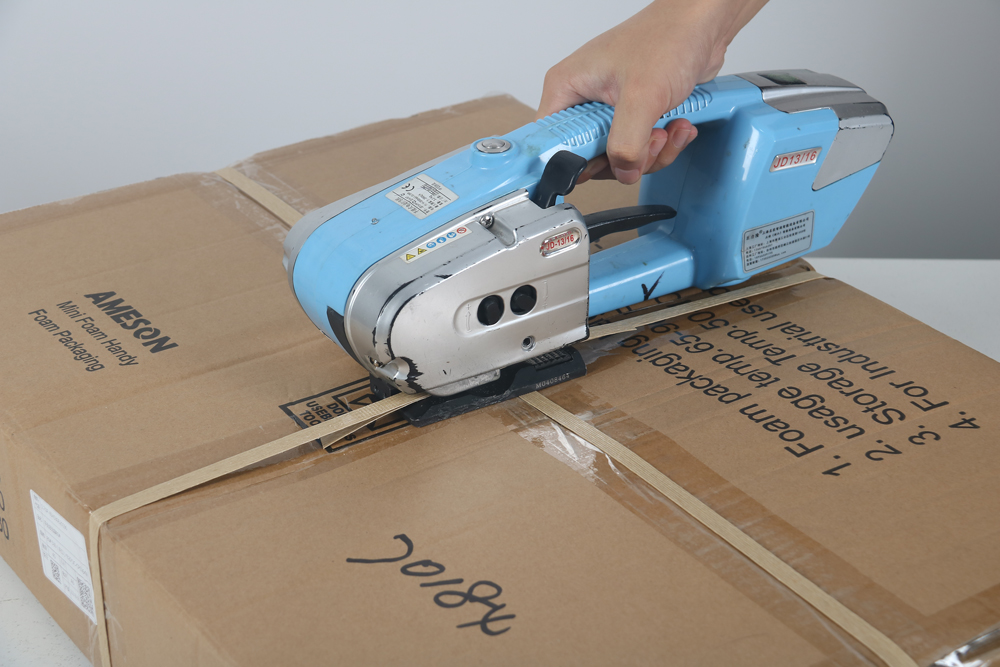
Yes. Both paper fiber and plant fiber strapping are designed for tool-free application. They can be wrapped, tensioned, and secured by hand without investing in large machinery. If your facility processes higher volumes and needs faster packing, both types can also be used with the Ameson Handheld Electric Strapping Tool.
Match the material directly to your daily packing requirements using this guide:
| Your packaging need | Recommended option |
| Cartons and everyday packages | Paper Fiber Strapping |
| Bundling products | Paper Fiber Strapping |
| Manual packing | Either, depending on the load |
| Pallet packaging | Plant Fiber Strapping |
| Heavy cartons | Plant Fiber Strapping |
| Bulk or palletized goods | Plant Fiber Strapping |
Yes, for light to medium-duty applications like securing cartons and bundling. For heavy-duty palletizing, plant fiber strapping is the appropriate plant-based alternative to plastic strapping.
Yes. Plant fiber strapping is designed to handle the higher tension and load-bearing requirements of pallets and bulk goods.
Both materials are designed for manual, tool-free application. The better choice depends more on the load and packaging application than on the method of application.
Yes. If your packaging needs shift from standard cartons to heavier shipments or pallets, choosing plant fiber strapping can provide the higher strength and tension capacity needed for heavier loads and palletized goods.
No. Both can be applied manually. However, they are fully compatible with handheld electric strapping tools for faster, high-volume operation.